

The title is of course a pun. While Nvidia’s CEO Jensen Huang describes the AI ecosystem in five layers, Huawei, the Chinese tech conglomerate, recently mapped it across eighteen layers. In Chinese culture, on the mention of “十八層” and another famous eighteen-layer structure comes to mind. It is called 十八層地獄, which refers to the eighteen levels of hell, according to Taoist beliefs.
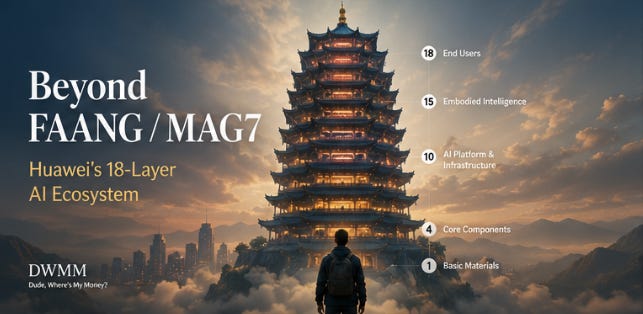
Apart from a false reference that Huawei is building an AI inferno, the eighteen layers of AI ecosystem do illustrate just how deep, complex, and vertically integrated its AI ambitions have become. And, in a way, how they have to get through hell to achieve them.
Referring back to Jensen Huang’s favorite way of explaining the AI ecosystem, which he calls a five-layer cake consisting of sectors in energy, chips, infrastructure, models and applications, that are stacked bottom to top. Each of these layers is impossible to operate independently without the one beneath it.1 It is a very useful mental model and definitely a framework that puts Nvidia’s own business right in the load-bearing middle of the story.
Huawei’s chief scientist’s eighteen layers are cited in an article published on 4 August by a Taiwanese e-media, TechNews (link in footnote 2). Apart from dissecting the AI ecosystem into eighteen layers, the Huawei team further grouped them into five broader tiers, including foundational, manufacturing, hardware, software, as well as algorithm and application.2 It is a far more granular map, coming from a company that has had to build almost the entire stack itself, largely without access to the Western tooling that everyone else takes for granted.
A couple of details from that article are noteworthy. These details provide some explanations of why the upper layers probably matter more than what news headlines suggest. Firstly, Moore’s Law has been quietly broken in a way that, past the 16nm and 7nm nodes, the cost per transistor stops falling with each new process shrink. Their performance and power efficiency, however, will continue to improve. In terms of the cost dimension, which is the part that was used to make “just wait for the next node” a viable strategy, it has effectively stalled.2 Secondly, Huawei reportedly tapes out around 70 new chip designs annually with almost zero major failures. This is an execution rate that is unusual because any single failed design could mean an entire mask set getting scrapped and restarted. With this, we are speaking about a whole 18-month development cycle going down with it.2 This phenomenon may help to explain why so much energy in this industry has shifted toward the layers above raw silicon since any advancement in shrinking transistors is no longer the easy win it used to be.
We noticed almost all the AI stocks that most retail investors hear about fall within the bottom one-third of Huawei’s eighteen layers of the AI ecosystem. They are namely the energy, chips, and advanced packaging sectors. The reason is simple. These sectors are not just well covered by Western financial media versus the rest of the stack, they are also the clearest and most visually satisfying stories. Put simply, it is not uncommon to hear about how bigger chips bring faster networks and more power. On the other hand, the layers above them (namely sectors involving compiler and runtime software, model training methodology, inference optimization, and agent frameworks) do not attract as much attention, despite being as essential to whether any of the bottom layers can turn into profit.
The rest of the article attempts to understand the rest of the tower as we cover each layer.
Where the trades are already crowded
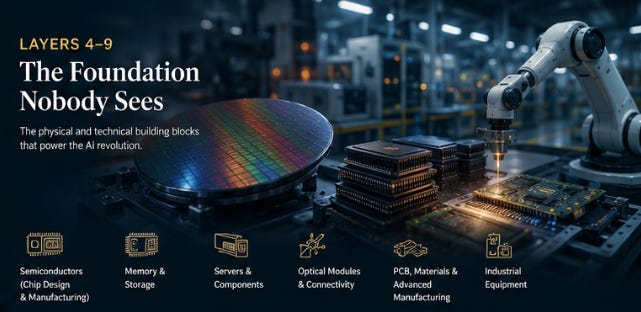
The fourth to ninth layers of Huawei’s framework consist of companies involved with the business of silicon and materials through advanced packaging and chip architecture. It involves the integration of multiple semiconductor components into a single package, enabling them to communicate with high bandwidth and low latency. This is currently the most sought-after sector within the AI ecosystem and includes companies like Astera Labs, Rambus, Coherent, and Lumentum. In fact, these companies have gotten so hot that their valuations have gotten excessive by historical standards. This implies that a lot of good news has been priced into their stock prices. Therefore, without considering other factors, there is little reason to revisit these sectors.
Layer 10: Compiler and Runtime
This is the layer where a trained model translates into instructions for a specific chip to execute. It is believed this is Nvidia’s true moat, which, to many’s surprise, is in the software instead of the silicon itself. The real advantage lies in CUDA, a decade-old software layer that makes Nvidia chips easy to program. This software layer also keeps out competitors’ chips, making the latter’s adoption harder. In fact, the opportunity cost of switching out of Nvidia’s ecosystem may be high for businesses already in it. Take AMD’s chips as an example. By itself, they definitely look competitive, but they continue to lose market share because the software ecosystem around them is far thinner.
To further illustrate this, Huawei’s engineers made a striking comparison of this gap. According to them, Nvidia’s Blackwell architecture currently offers about 32 times the computational headroom, a success very much attributed to CUDA’s maturity. In comparison, Huawei’s Ascend chips provide only about 8 times the computational headroom. One of their scientists illustrated the vast difference with an analogy of a villa versus a small apartment. While both have “space to grow,” the potential of their outcomes is on a vastly different scale. To narrow this gap, Huawei turns to focus on its full-stack software–hardware co-design and cluster-level networking. This is the opposite of what industry watchers expected: that they would chase down Nvidia’s raw specifications card for card. Huawei tries to compensate at the system level rather than competing over their chips, in which they are disadvantaged. The company also reportedly follows a rhythm in its iterations: software changes that take an hour to test quickly reveal the real bottlenecks in a system, which are then fed back into the next hardware revision. This is a cycle that takes about 18 months. Compared to the past, when hardware dictated the direction of software, this marks a quiet acknowledgment of how much influence software now has in guiding hardware design.
There is currently no pure-play public company operating here from the perspectives of this investment thesis. Regardless, we can identify relevant businesses bundled inside a chipmaker’s moat (e.g., Nvidia or AMD). Some are open-sourced by model providers (e.g., OpenAI’s Triton), while others are companies that remained private (e.g., Modular, founded by a former Apple and Google compiler engineer). One possible option for investors could be buying into Nvidia. However, this means getting exposure to its hardware business as well. Nonetheless, the 32x-versus-8x gap described by Huawei above will likely serve as a useful proxy for now for how far a gap competitors still have to cover before that lock-in becomes less relevant.
Layer 11 and 12: Operator Partitioning and Quantization
The layers of operator partitioning and quantization are responsible for splitting a model’s computation efficiently across multiple chips. In addition, they perform tasks like compressing models to run faster and cheaper, with the aim of not losing too much accuracy. These functions form structural roles in determining whether AI inferences can become cheap enough for mass adoption. Regretably, retail investors are not able to invest in these businesses since they do not exist as standalone companies. They are usually part of a mega company’s software stack, eg Nvidia’s TensorRT. While it is worth knowing how these layers exist and function, it is unlikely to be an investment thesis that can be pursued any time soon.

Layer 13 and 14: Training Methods and Foundation Models
When most people hear of “AI companies”, names like OpenAI, Anthropic, Google DeepMind, Meta AI, and xAI comes to mind. This is the exact layer these companies come under. However, it is not easy for retain investors to gain exposure to these pure play companies since they are mostly private companies. The two largest independent labs, OpenAI and Anthropic, are wildly sought after as to when they will list on the stock exchanges. For now, investors will have to go by the private equities route to gain exposure to them. Interestingly, layers 13 and 24 are also the layers where the money actually concentrates. Some of these businesses are cash printers. If one prefers not to go by the private markets route, they can choose to invest into publicly listed companies with stakes in these private companies. Microsoft holds an equity stake in OpenAI, while Alphabet owns DeepMind and Gemini (its own model). None of these Magnificent 7 companies are pure-plays but they are the closest availability on a public exchange to gain exposure to layer 13 and 14 companies.
An interesting event to point out for investing in this domain happened in January 2025. DeepSeek, a company founded by AI enthusiast Liang Wenfeng out-built every company on the street with fewer parameters and compute. Apparently, Liang reportedly opted for sparse activation (with attention limited to a short 512-to-1K token window) instead of stacking more parameters.2 The release of DeepSeek caused a 18% drop in Nvidia’s share price after its download on the iOS in the US surpassed that of ChatGPT later in the month. DeepSeek’s approach was described by Huawei’s chief scientist as a top-level architectural choice, instead of a minor algorithm tweak, that achieves its goal to cut across layers. 2 Since then, it has gotten to investors’ minds that the next shock to any company’s AI story may not come from a competitor buying more or better chips. Rather, when someone discovered a different path to achieve similar results with far fewer resources, the impact to the markets will be even more shocking. This unknown has always the hardest risk to avoid historically when it comes to investing.

Layer 15: KV Cache and Inference
It is not easy to understand what inference is. A search on google will find a definition on Cloudflare’s website where it mentioned that inference is “the process that a trained machine learning model (machine learning is a type of AI) uses to draw conclusions from brand-new data”. There are a handful of specialist chipmakers that have built inference faster and cheaper than general-purpose GPUs. These companies include Groq, Cerebras, and SambaNova.
There are two market events that had turned the layer of inference into a hotly contested one in the AI stack. The first event happened in December 2025 when Nvidia acquired Groq. Since 2024, Groq has been a company that Wall Street recognised as the clearest architectural threat to GPU-based inference.3 It is clear how Nvidia wish to take control of Groq technology when the former paid $20 billion to bring the latter under its arm. The second event happened 6 months later in May 2026. Groq’s closest competitor, Cerebras Systems Inc (CBRS), went public on Nasdaq, at a $56.4 billion valuation, making it the largest US IPO of 2026.4 When we saw how these two episodes develop, we cannot help but imagine a delicate scenario. The situation is so intense that an analyst covering CBRS’s listing wasted no blunt in a Forbes article, stating that Cerebras is “going public into an inference market the dominant supplier has already moved to consolidate.”4
While CBRS is a company with a real technological edge (its wafer-scale chips post faster inference speeds on certain workloads), it now have to compete directly against a megacap that just spent $20 billion to take control of this exact layer. It remains to be seen how this technology plays out inside a market structure where the largest player has already shown a willingness to consolidate aggressively.
Layer 16: Agent Frameworks
We have reached the level of the newest but already crowded field of incumbents. This is where software lets AI models take multi-step actions rather than simply answer single questions. This spectrum is being built almost entirely by companies you probably already own. Think of Microsoft (Copilot Studio, AutoGen), Salesforce (Agentforce), and/or ServiceNow (Now Assist). It is unlikely to find much of an “undiscovered” story within this stack since they are already well-covered incumbents racing to bundle agent capability into existing enterprise software. The open investment consideration here to raise (or a monetization skepticism to answer) is whether the bundling will continue generating new revenue or simply end up becoming an expected free feature.
Layer 17 and 18: User Product Capability and Commercial Applications
To be honest, this is the hardest layer to write about. The reason is simple - it is speculative almost by any definition. The companies that will matter most in another five years may not be public yet. In fact, they may not even exist at this point in time. Otherwise, they may just be a feature inside a much bigger company rather than a standalone business. Apart from that, today’s dominant players in this field will also have to continue staying relevant in maintaining their dominance.
There is a blunt industry law that Huawei’s chief scientist pointed to that is worth keeping in mind when investing in AI. He said that the closer a company sits to the end user, the more of the upstream profit it tends to absorb. Examples of these companies include Google and Apple, who owns enormous order volumes, which can effectively control technical standards and procurement terms. Such controls in turn squeezes the margin out of every entity upstream of them.2 To add to that, production of a chip typically takes about three years from initial design to mass production. This implies that by the time it starts to ship, customer needs may have deviated from what it was originally built for.2 This is a showcase of how layers furthest from the user have to take a multi-year bet on where demand will be by the time they are ready to ship their production. On the contrary, where the layers are closest to the user, they are also structurally positioned to capture this revenue at everyone else’s expense through terms stated above.
The value at this layer accrues to whoever can turn layers beneath it into recurring revenue that businesses or consumers are willing to pay for. Palantir is one of the companies that is on hypergrowth valuation cycles. The data integration and analytics software company is arguably the clearest example of one already living at this layer, despite having to deal with the market’s ongoing scepticism about how much to pay for that positioning.

Where this leaves us
By going through Huawei’s 18 layers of the AI ecosystem, it has provided us with further insights about the AI ecosystem. The most obvious sectors within the ecosystem gravitated almost entirely toward layers four through nine. They are the chips, packaging, and photonics because these are the parts of the AI stack that are easiest to identify for investment considerations. The layers above them, which find the software that makes chips usable, the methods that make training work, and the economics of inference, are seldom in the picture because they are harder to photograph.
We started out wondering if there is a “beyond FAANG/MAG7” thesis worth taking seriously. It seems unlikely to find the next single ticker or group of tickers. A better approach would be about recognizing which layer of the stack we are comfortable getting exposure to. However, crucial decisions have to be made about how much of that layer still stays private, is in a phase of being consolidated by an incumbent, or an investment call which is too early to make. The example of when Cerebras went public five months after Nvidia bought its biggest rival is as good a summary of that tension this entire industry is likely to offer for a while.
Not investment advice. Just how I’m thinking about it.
錢途始於思維
Footnotes:
1. NVIDIA CEO Jensen Huang’s “five layer cake” framework (energy, chips, infrastructure, models, applications):
2. Huawei Fellow and chief semiconductor scientist Liao Heng’s “eighteen-layer tower” framework for the AI ecosystem, as reported by TechNews (科技新報):
https://technews.tw/2026/08/04/huawei-semiconductor-18-layer-pagoda/3. Nvidia’s approximately $20 billion acquisition of Groq’s technology:
https://www.cnbc.com/2026/05/15/nvidia-cerebras-stock-price-ipo.html
4. Cerebras Systems’ Nasdaq IPO (ticker: CBRS) in May 2026: